Update: 2026-10-15 - a few people got in touch saying that they’d found this write-up useful, I’ve improved a bit with a better set of side-by-side visuals showing how Jev compares to a regular LLM and more detail on how the models work, some emerging use-cases and Jev’s most recent improvements which include support for image modality.
I’ve been travelling in the mountains for a couple of weeks. Being disconnected from technology while in the hills has been lovely but there was one topic in particular I was itching to get my hands into and do a short non-tech and tech overview on, which is Jev and System 1 models.
TypeSafe AI1 released a new type of model called “Jev” which they described as a “System 1 model” (others have been describing it as a “Decision Model”2) - there has been a lot of excitement and hype.
I really recommend reading their Release Announcement - and then if it doesn’t entirely make sense then please read on. I’ll try and explain what it means, whether you should care, show a fun example of a decision model playing Space Invaders very quickly (then a regular LLM playing a game more strategically) and then a potentially more serious example of using a decision model to quickly check for potential fraud (at moderately high frequency).
I have tried to create a side-by-side visual comparison showing the fundamental differences between a regular large language model and a System 1 model. Over the course of this article these differences will be explained in detail:
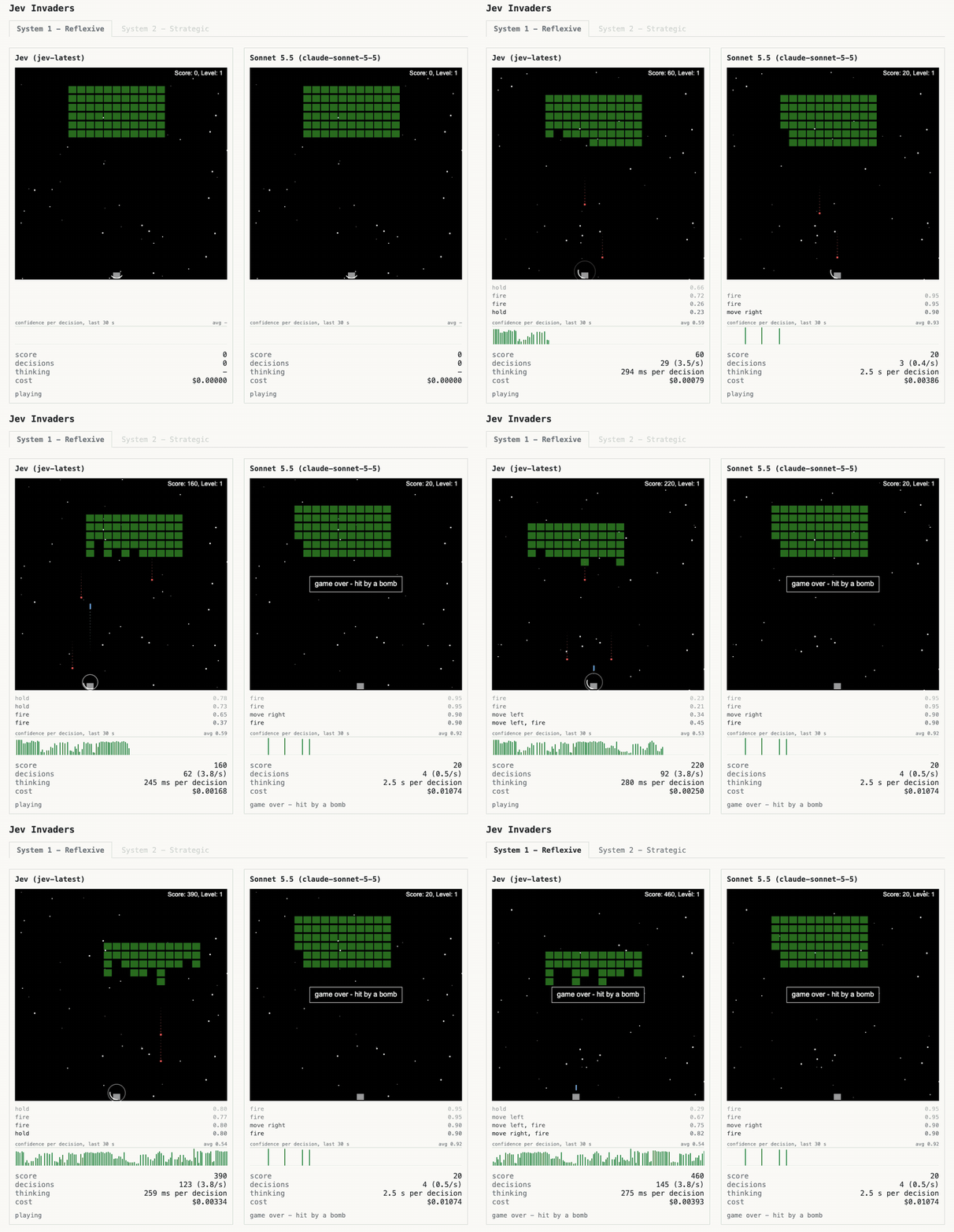
As a delightful hook, enjoy the gif below of a decision model and a regular large language model playing Space Invaders (and then later, playing Connect Four against each other):
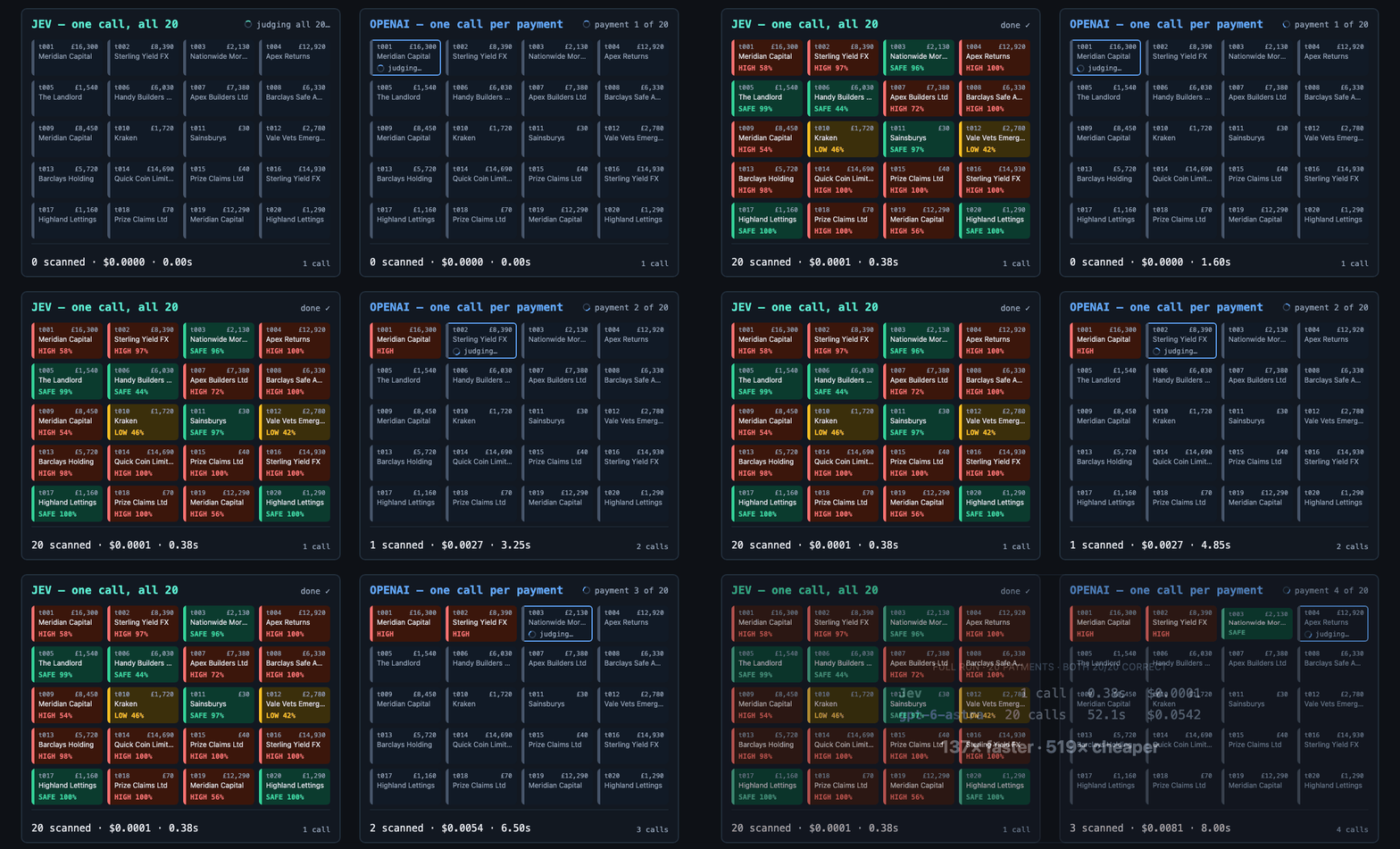
And a quite janky gif that attempts to visualise the more serious example we’ll walk through of trying to scan a large number of payment instructions for fraud.
Hopefully by the end of this article the content in the Jev Launch Announcement will make more sense.
Refresher - Completion Models
First a brief review of what a regular large-language completion model like ChatGPT is. LLMs are trained on vast amounts of data and essentially encode the semantics of language. The training data includes a huge amount of human knowledge and opinion (think the beauty of Wikipedia and the horror of some social media). They are very good at modelling patterns in language and can give very compelling answers to complex questions.
There’s an interactive visual that is super simplified on how an LLM works that I published here, you can click it to see the interactive version:

Words and concepts positioned by meaning - a frame from my interactive guide, LLMs Visualised.
Given input, an LLM provides the most statistically likely response based on how it is trained:
Input: What is the capital of France?
Output: Paris
These are completion models - they complete text. Conversational models have been further trained to answer in a conversational format (this is where the ‘Chat’ in ‘ChatGPT’ comes from):
Input: What is the capital of France?
Output: Paris - a beautiful and famous city. What would you like to know about Paris - are you visiting, should I build you an itinerary? Or just curious?
Training models takes a vast amount of data and compute and is hugely expensive. Running them is also very expensive, so model providers charge based on the size of input and the amount of output. Output is normally more expensive. Better quality models are more expensive, faster output is usually more expensive and there are a raft of options to choose from - frontier labs, smaller labs, open weights, self-hosted, and so on.
Decision Models vs Completion Models
A ‘decision model’ does not complete text. You hand it some state (context or information) and one or more typed questions, and for each it gives an answer or judgement in the form of:
- a noul - the probability, from 0 to 1, that a statement is true
- a choice - one option from a set you define (with a confidence score on each option)
- a score - a position on a scale you define, again with probabilities and a confidence.
Here’s a trivial example - we give state saying that the capital of France is Paris, and then ask whether the statement is true.
Input
{
  "state": "The capital of France is Paris.",
  "model": "jev-latest",
  "questions": {
    "is_true": { "type": "noul", "instructions": "Is this statement true?" }
  }
}
Output
{
  "answers": {
    "is_true": { "type": "noul", "noul": 0.99 }
  }
}
The response comes back as 99% likely the statement is true. We’re not getting back a text response (such as “Yes”) or a conversational response.
Here are a couple more. Scoring how opinionated a piece of text is (a score, a position on a scale you define, with a probability for each level):
{
  "state": "This laptop is overpriced garbage and only a fool would buy it.",
  "model": "jev-latest",
  "questions": {
    "opinion": {
      "type": "score",
      "instructions": "How opinionated is this text?",
      "criteria": ["Neutral fact", "Mixed", "Strong opinion"]
    }
  }
}
{
  "answers": {
    "opinion": {
      "type": "score",
      "score": 1.9,
      "legend": { "0": "Neutral fact", "1": "Mixed", "2": "Strong opinion" },
      "probabilities": { "0": 0.0, "1": 0.1, "2": 0.9 },
      "confidence": 0.94
    }
  }
}
In this case the judgement is that, on our scale, the statement sits 90% in the ‘strong opinion’ bucket (rather than, say, ’neutral fact’).
Another example - judging an action against a set of rules (a choice, one option from a set, with a probability for every option plus an overall confidence, which is quite similar to a score except that a single specific value from the set is chosen):
{
  "state": {
    "regulations": "<all compliance policies for the business>",
    "action": "Offer to connect the user with fellow investors"
  },
  "model": "jev-latest",
  "questions": {
    "verdict": {
      "type": "choice",
      "instructions": "Given the regulations, how risky is this action?",
      "criteria": {
        "compliant": "Clearly allowed",
        "needs_review": "Ambiguous - a human should check",
        "prohibited": "Likely breaches the rules"
      }
    }
  }
}
{
  "answers": {
    "verdict": {
      "type": "choice",
      "choice": "prohibited",
      "probabilities": { "compliant": 0.04, "needs_review": 0.15, "prohibited": 0.81 },
      "confidence": 0.9
    }
  }
}
We give the model a bunch of policy data, and then ask it to categorise whether a certain action might be a violation.
The important note is that the output is free and comes back very quickly3, and that you can get the answers to many questions in a single pass (which is called a ‘fan-out’).
Visualising Completion Models vs Decision Models
To recap, there are a couple of really important differences between regular LLMs and decision models:
- LLMs are unstructured - decision models are structured: we can try and push LLMs to treat input as structured, but we’re relying on the training of the model to respect that (or code that wraps the model and asks it to recreate output again it it seems to not be well structured). This essentially takes effort and overhead if we want to deal with structured data natively.
- LLMs generate output character by character - decision models produce all output in one go: With an LLM, even simple output such as a short JSON structure requires prefill plus a forward pass per output token. Decision models are essentially classifiers: the single prefill step produces the entire output (a distribution, which is then serialized to JSON). This is also what allows us to ‘fan out’ - which is what makes a model seem like it is making many decisions in parallel (its still one round through the model, but the input can be complex and represent many requests - the output is still produced in one go)
To illustrate, I have put together the visualisation below:
- On the left, we are trying to force a structured approach. Models are well-trained to handle this, but can make mistakes. Conversational models in particular are trained to be conversational and can be noisy. On the right, we are using native structured data.
- On the left, we see that every output token requires a full forward pass. Even if the output is small there is a lot of work going on. On the right, a single prefill step produces the entire response in one go.
(By the way, if you are interested in how I make visuals like this, and what a surprising amount of effort it is, check my How I use AI in Writing page.)
Fun example - System 1 models playing Space Invaders fast vs System 2 models playing strategically
13 years ago I built my own version of the “Space Invaders” game whilst learning JavaScript (my mind boggles at the changes since then). A fun use case can be made of this - give the state of the game to Jev and ask it to decide on the best action (move / fire). As Jev is low latency it should come back very quickly and play real-time4. An LLM like Sonnet will need a bit more massaging and will take longer (as we’re using a complex model that can use reasoning to answer a more simple question, essentially over-gunning it).
We can also make a game that is more suited to a model like Sonnet - in Connect Four there is more strategy and longer term planning involved, so an LLM with reasoning should be able to out-play a simple decision model.
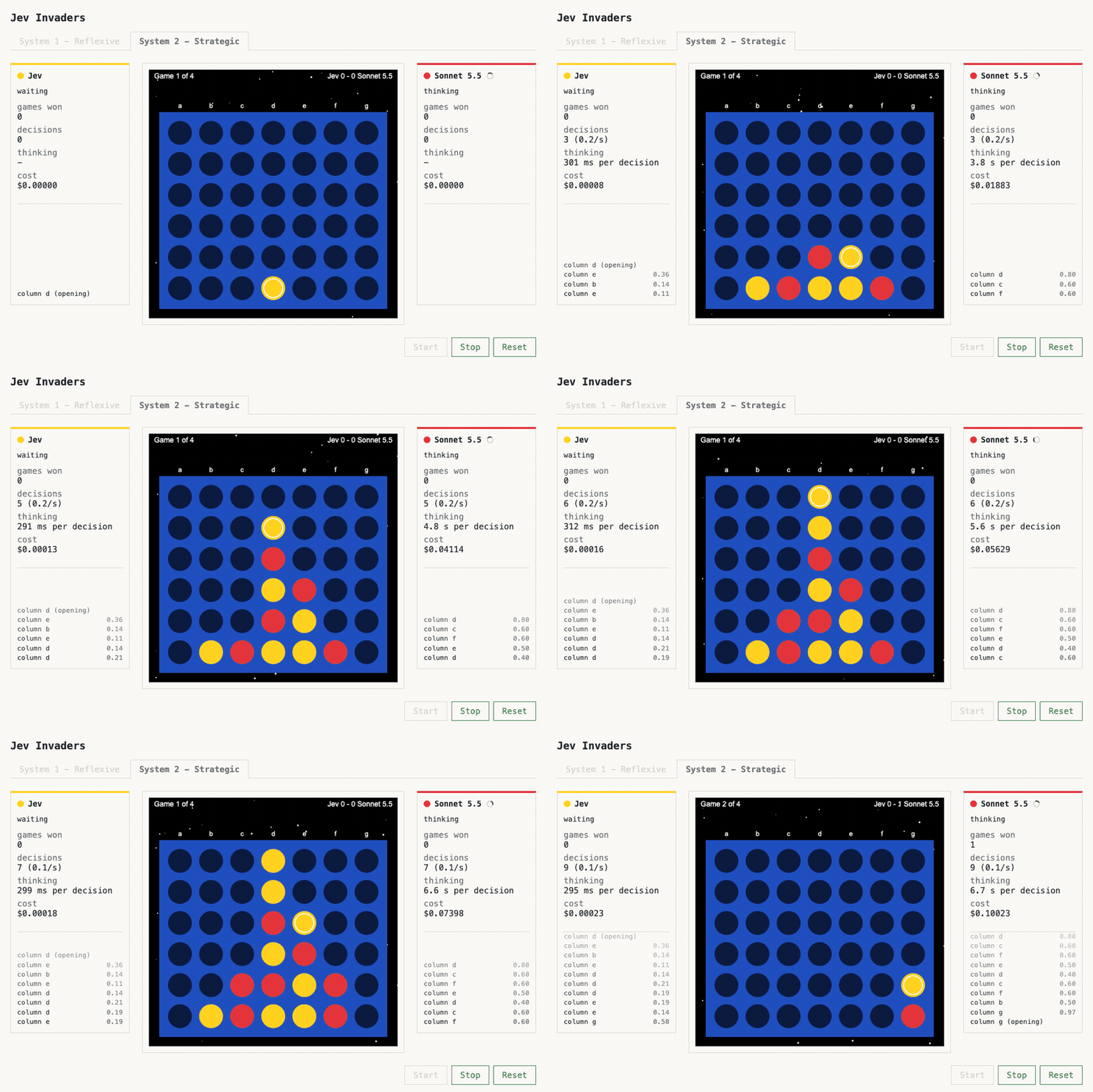
The source is in the original Space Invaders repo. You can play the OG 13 year old one or clone it and run the System 1/2 version locally with your own keys. This is a fun example to play with and shows the rough idea.
A more serious example - rapid judgements on potential fraud
In this example we give the decision model a rolling window of recent scam signals (company names, or text associated with fraud) as shared context, then (in a single call) ask one question per transaction whether each of a batch is safe, low-risk or high-risk, with a confidence. An application on top of this could fire a popup asking for confirmation for low-risk cases or block high-risk cases5.
{
  "state": {
    "todays_scam_patterns": [
      "'safe account' scam: caller poses as the bank, urges moving funds",
      "private car sale: urgent same-day payment to a brand-new payee"
    ],
    "flagged_payees_24h": ["QuickCoin Ltd", "J. Marku"]
  },
  "model": "jev-latest",
  "questions": {
    "txn_1": {
      "type": "choice",
      "instructions": "£14,900 to 'Quick Coin Limited', new payee, 3x normal limit, 23:40. Reason given: 'buying a car from a private seller'.",
      "criteria": { "safe": "...", "low": "...", "high": "..." }
    },
    "txn_2": {
      "type": "choice",
      "instructions": "£42 to 'Tesco', a regular payee. Reason given: 'weekly shop'.",
      "criteria": { "safe": "...", "low": "...", "high": "..." }
    }
    // ... one more question per transaction, up to a full batch
  }
}
{
  "answers": {
    "txn_1": {
      "type": "choice", "choice": "high",
      "probabilities": { "safe": 0.05, "low": 0.15, "high": 0.80 },
      "confidence": 0.83
    },
    "txn_2": {
      "type": "choice", "choice": "safe",
      "probabilities": { "safe": 0.97, "low": 0.03, "high": 0.0 },
      "confidence": 0.95
    }
  }
}
The nice thing here is that we batch. The state (the scam data) is read once and every transaction-question runs against it in parallel - what TypeSafe call fan-out6. We still get the benefit of semantics7 - an exact blocklist would miss “Quick Coin Limited” (yesterday’s flagged payee was “QuickCoin Ltd”), but the fuzzy semantic match - a near-miss name plus a narrative that resembles today’s car-sale scam - still fires. That is the bit a decision model adds over rules, and it is much harder for a regular LLM to do at this speed and price8.
Another quick experiment - twenty transactions through Jev and four frontier models, scored against known labels (the little harness is in sample/):
| Model | Accuracy | Cost | Time | Calls |
|---|---|---|---|---|
| Jev | 100% | $0.0001 | 0.4s | 1 |
| Sonnet | 85% | $0.01 | 33s | 20 |
| Luna (GPT-6) | 100% | $0.0008 | 40s | 20 |
| Astra (GPT-6) | 100% | $0.05 | 52s | 20 |
| Opus | 100% | $0.04 | 81s | 20 |
The accuracy is much of a muchness on twenty fairly clear cases - don’t read too much into that column. The gap that matters more is that Jev judged the whole batch in one call, in under half a second, for a fraction of a penny; each LLM made twenty calls and took the best part of a minute.
This emphatically does not mean that Jev is good at judgements and frontier models are bad. Both are essentially based on the same technology; it is more that Jev is architected for fast, parallelisable questions over a dataset, whereas LLMs are architected for more complex reasoning - and a model like Jev (or any of the competitors springing up) might be a better choice for some sorts of tasks. The footnotes at the end of the article highlight some examples of how models are not great at handling adversarial data.
As an executive or technologist, should you care
Yes - it is useful to understand at least at a (very) high level what the fuss is about, partly to just separate out the noise (everyone who is releasing something new wants to show it as groundbreaking). Jev - and System 1 models generally - are a well-made new tool for the toolbox. They still rely on training data, and they don’t truly have judgement - they lean on semantics and relationships - but for many tasks that is fine, and worth looking into more deeply.
Whether this is novel is arguable - without knowing the internals it is possible that simply taking an open weights model and doing the same thing via prompt engineering is also ‘good enough’ or whether a model post-trained on your own data would in fact be better - but there are a nearly infinite number of use cases we can imagine and many may be served well by this technology9.
Jev launched on 15 September; within two weeks Together AI, Upstage and Liquid AI had shipped their own decision models, a clutch of open-weight clones appeared, and on 29 September OpenAI put its weight behind the shape with a Decisions API - though that one is a constrained frontier model (GPT-6 Luna with its output fenced to your options) rather than a purpose-built decision model like Jev10.
Possibly as an exec you might ask someone in your tech team to look at this, run a couple of experiments in your own domain, and share their learnings to your leadership team. More contextualised will be far more interesting and their real-world experience will be great to see (and probably a fun experiment for them to run).
That’s the high level view - my post travel backlog is quite large so this is a short one but I hope you found it at least mildly interesting. No tokens were harmed during the writing of the text, but I have used AI to check references, spellcheck / grab screenshots from my other projects and so on.
Update: Emerging Use-Cases
After many discussions with colleagues and following what’s happening online, a few use-cases are emerging:
Triage or Safety Checks
Just like the fraud example in this post, quickly classify a set of transactions or operations to determine the path for further processing. Depending on the classification we might run a straight-through process, introduce some friction like an OTP verification, or require a full human-in-the-loop review.
Routing
A little similar to the above, one example I’ve seen a bit is taking input text and deciding what model might be most appropriate to use, for example routing requests that appear to be simple to lower-cost LLMs and requests that might involve complex requirements around images to more specialised models.
Selection
Quickly picking an option from a set, for example looking at a codebase and deciding what set of skills might be appropriate to use when running long coding operations.
Classification
You could describe a System 1 model as a generalised zero-shot classifier. This makes it quite suitable for taking any kind of input data and deciding what category the input belongs to from a set - for example, is the description of an issue on GitHub a bug, epic, story, feature request, discussion.
Update: Recent Improvements
Image Support
This is a fairly significant update. Images can be used in state, instructions or criteria. For example you could grab a photo of someone in your company swag and someone in suit, then ask Jev to classify a large set of photos - is this more likely to be one of your coders or your executives.
Boxes
A box output can be used to describe part of an image. For example, you could use the model to say “find the hat”.
Here’s a quick test of both: classifying photos as coders or executives using a reference image for each, then boxing the logo on a hoodie. Click through for the full requests and responses:
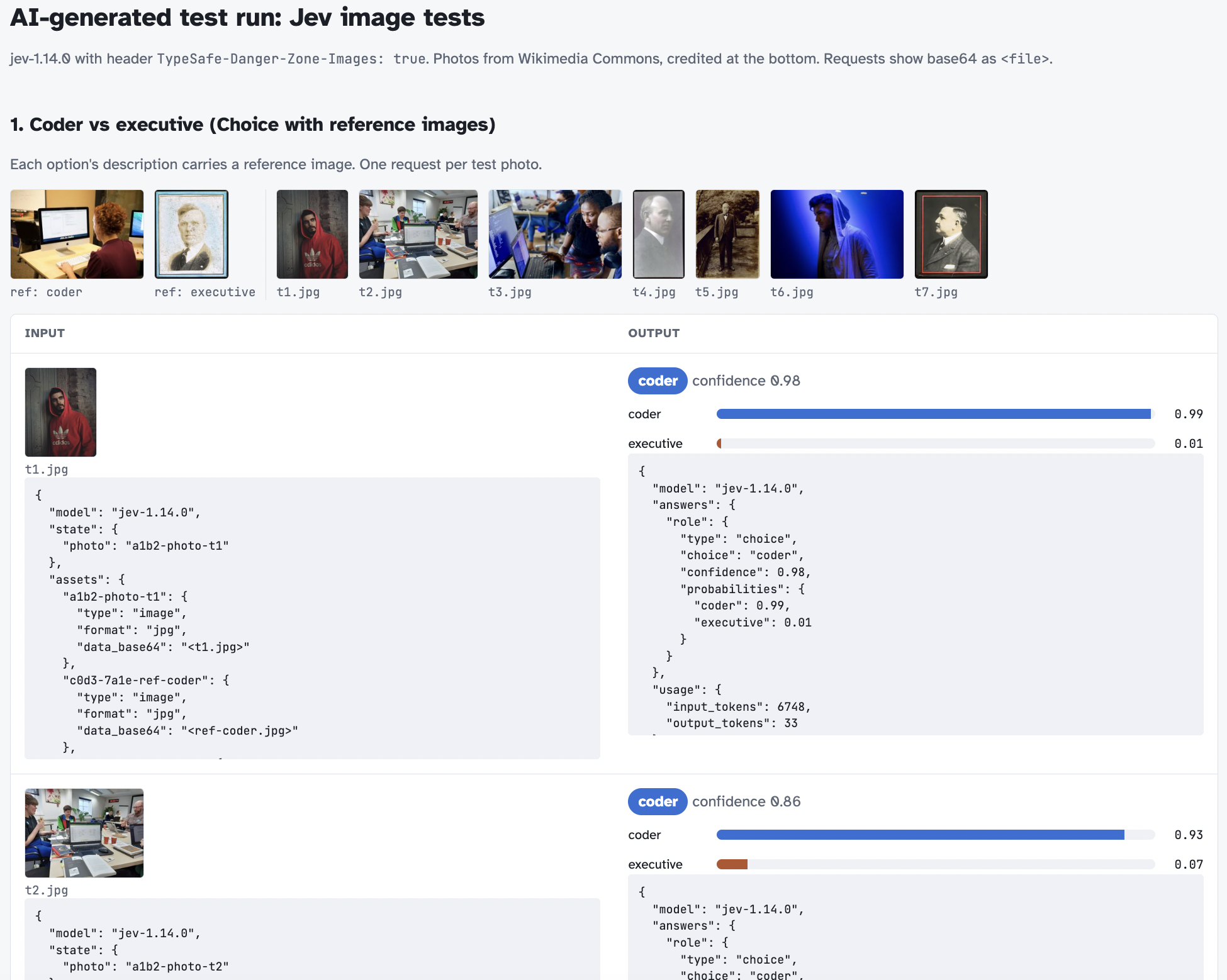
Warning: this is an AI-generated test run, put together as a quick illustration. An AI assistant wrote the scripts, ran them against jev-1.14.0 and built the output html.
Links: the TypeSafe / Jev announcement, and the growing list of decision models on OpenRouter.
TypeSafe AI, a San Francisco startup founded by former OpenAI researcher Diogo Almeida, came out of stealth on 15 September 2026 with a $40M seed round led by DCVC. ↩︎
“System One” is a nod to Kahneman’s Thinking, Fast and Slow - the fast, automatic mode of thought, as against the slow, deliberate “System Two” (a fair description of a reasoning LLM). Simon Willison prefers “decision model”, a name he credits to Maggie Appleton: Jev introduces a new shape of LLM. Worth noting Jev is one product and others are already appearing, so the terms aren’t truly synonymous. ↩︎
TypeSafe’s own figures: input at $0.042 per million tokens, output “too cheap to meter”, end-to-end latency of 70-500ms, and 40-200x faster than a frontier LLM on these “System One shaped” queries. So indeed, comparatively very cheap and fast. ↩︎
Of course it is vastly cheaper and easier to just train a model to play Space Invaders - regular machine learning, or even a few lines of hand-written logic, would beat Jev and cost nothing per move. This is only an example for fun; the point is a general model reacting to described state, not the best way to play the game. ↩︎
This is exactly the pattern security researchers broke. A typed output constrains the format of the answer, not the credibility of the input - so you can slip fabricated evidence into the documents and flip the verdict. Check Point manipulated Jev’s decisions roughly 59% of the time, at about $0.50 a go, with no reasoning trace for the analyst to spot: “Jev Is Not a Language Model, but It Breaks Like One”. If you use it as a gate, screen the inputs before Jev sees them; don’t trust the tidy number afterwards. TypeSafe’s own limitations page now concedes that adversarial content - injected instructions, or “text that argues for its own classification” - can move the answer, and there is an arXiv write-up (Decision Hijacking, 2026) documenting the same. ↩︎
TypeSafe call this “speculative fan-out” - one state, many questions, all evaluated in parallel against the state read once. They report roughly 12x cheaper and 10x faster for 13 questions in a single call versus 13 separate calls. The state plus all questions must fit a ~64k-token budget, and there is no prefix/input caching - so batching, rather than one call per transaction re-sending the window, is what keeps it cheap. ↩︎
TypeSafe’s own documentation says Jev is “not great with numbers, dates, or adversarial content” - worth sitting with, given that fraud and regulatory text is adversarial by nature and full of amounts and dates. ↩︎
You can coax a number out of a normal LLM -
Answer with a single number between 0 and 1 only, where 0 is 0% and 1 is 100%- but you pay for the generated tokens and the latency, and the number tends to be poorly calibrated. The genuinely new part of Jev isn’t “a model that emits a number” - it’s calibration: TypeSafe train with a method they call Reinforcement Learning for Calibrated Decisions so that (they claim) a stated confidence matches real accuracy, faster and cheaper than an LLM. Take it with a pinch of salt - they concede their own hallucination figure is “not empirical”, and what is actually guaranteed is only that the output matches the requested schema (a 0% type-error rate), not that it is right. ↩︎Analysts expect the big labs to ship their own decision models quickly, and the category is already forming - by late September 2026 OpenRouter was listing several such models from multiple publishers. The interesting question isn’t whether Jev specifically wins, but whether “typed, calibrated decisions as a cheap function call” becomes a standard part of the stack. ↩︎
OpenAI’s Decisions API was announced at DevDay on 29 September 2026 and is in limited preview; at the time of writing its price, and whether it exposes a full probability distribution the way Jev does, are not confirmed. Other September 2026 entrants include Together AI’s Tev (with an open training recipe), Upstage’s Solar Decide, Liquid AI’s d1 and meraGPT’s Decider 1, alongside open-weight clones. ↩︎